Removing Old Recessed Lights and Going Flush
Swapping old cans for thin LED wafers or a single flush fixture leaves openings that no trim will cover.
Moved your lighting and now staring at a row of round holes? Kingston Drywall patches old pot light openings so your ceiling looks like they were never there. We work for homeowners, electricians and renovators across Kingston and nearby towns.
After 20+ years and more than 2,500 drywall jobs, we know round ceiling holes are one of the hardest patches to hide. Light rakes across a ceiling, so a patch that is even slightly proud or poorly feathered shows up as a halo.
We are licensed, insured and WSIB covered, and we coordinate with your electrician so you are not left waiting weeks between trades.
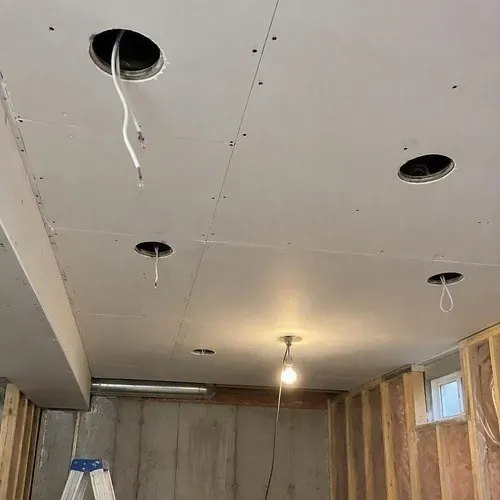
Maybe your electrician just changed the layout. Maybe you switched to flush-mount LED fixtures, or bought a house with track lighting and a dozen holes.
Either way, you have four to twelve round openings and a ceiling that needs to look whole again. That is exactly the job this service is built for.
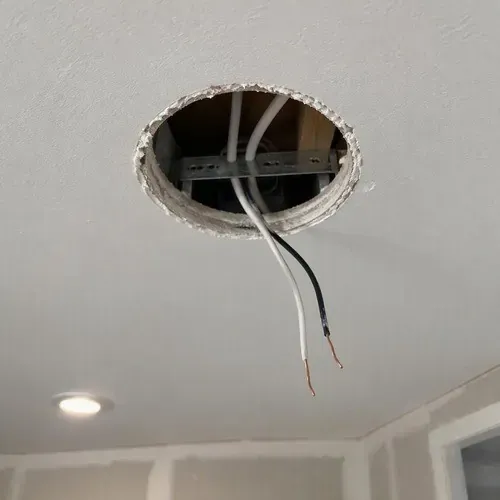
Swapping old cans for thin LED wafers or a single flush fixture leaves openings that no trim will cover.
Old holes are patched and new ones cut in the same visit. The whole ceiling is then finished together so the patches blend.
A 6 in. hole for a 4 in. trim, or a hole cut into a joist, has to be reduced or moved. We rebuild the opening to the right size.
A wandering hole saw leaves ragged edges and torn face paper. Torn paper is sealed before patching so it cannot bubble later.
Fan boxes and old fixture openings are larger and often have a cracked ring of paint and texture around them.
The hardest version of the job. After patching, the stipple or stucco texture has to be matched, which is why this is drywaller work, not handyman work.
Free written quotes with the finish level spelled out.
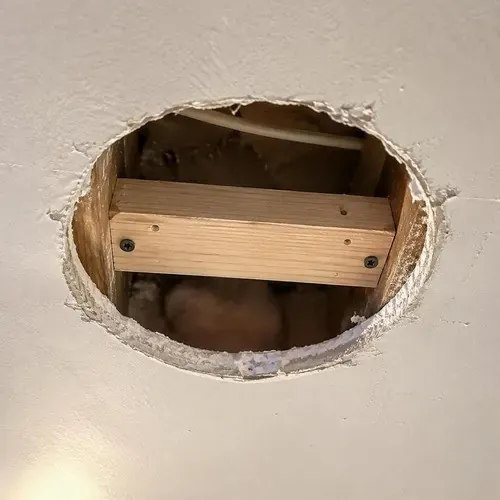
Solid backing goes behind the hole so the patch cannot sink or crack. Mesh over a void always fails eventually.
A drywall plug cut to fit the opening and screwed to the backing, flush with the ceiling.
Each coat is feathered wider, often 12 to 16 inches across, so the patch does not telegraph under light.
Stipple and knockdown are matched on a test board first. Smooth ceilings are skimmed and sanded flat.
Every patch is primed so it takes paint the same way as the rest of the ceiling.
Ceiling light comes from windows and fixtures at a low angle, so it rakes across the surface and throws a shadow off any high spot. Walls are usually lit more directly.
That is why a ceiling patch needs a wider feather and flatter sanding than the same patch on a wall.
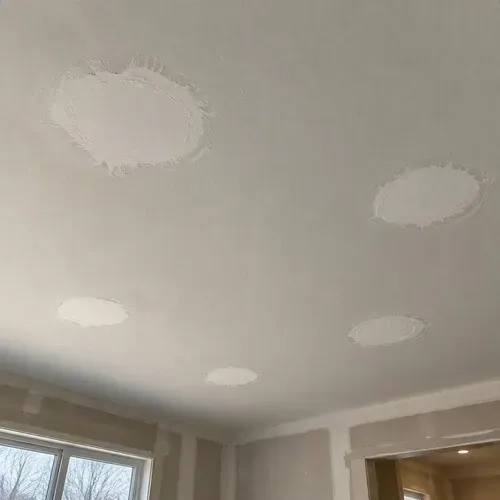
The order matters. Your electrician removes old fixtures, runs new wiring and cuts new openings first, then we patch and finish.
Tell us your electrician's schedule when you book and we will line up our visit right behind them. If you do not have an electrician yet, hire a licensed electrical contractor for the wiring, as Ontario requires, and we will work around their dates.
Send us a few photos for a faster estimate.
We price pot light patching per hole. Larger batches cost less per hole, because set-up, drying time and clean-up are shared across the whole ceiling.
Textured ceilings, oversized openings and holes cut through joists add to the price. Because the job is so predictable, it is ideal for a photo quote: send a picture of the ceiling and a count of the holes.
Straight answers to the questions we hear on site visits every week.
A single hole is priced higher per hole than a batch, since the set-up and return visit are the same either way. Send a photo and we will give you a price.
Yes. We patch the hole, then match the stipple on a test board before applying it to the ceiling. If the ceiling was installed before 1990, the texture should be tested for asbestos first.
Usually, yes. Primed patches blend well, but fresh paint on just the patches shows a sheen difference. Painting the ceiling edge to edge gives the best result.
The patching and first coat happen on the first visit. Compound needs to dry between coats, so a smooth, invisible finish takes a short return visit or two.
Yes, this is one of the most common calls we get. We close the misplaced hole and finish it so it disappears.
Bigger ceiling problems are covered by our ceiling repair service, and wall holes by drywall repair. If the texture around your lights needs matching, see textured ceiling and wall repairs.
Take a photo of the ceiling and count the holes. Email them to info@kingstondrywall.ca, or describe the job in the form, and we will reply with a price, often without needing a site visit.