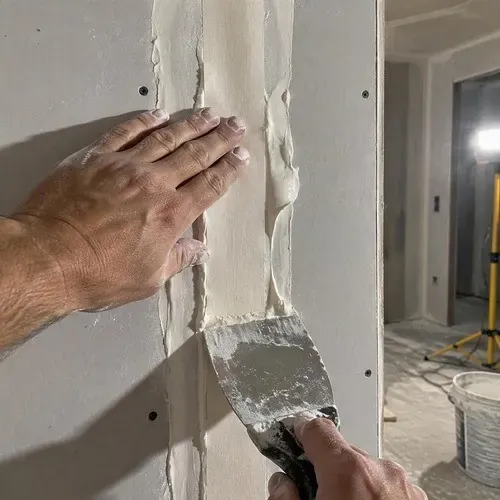
Flat and Butt Joints
Flat joints run along the tapered factory edges; butt joints meet at the untapered ends and need a much wider feather. Paper tape is stronger than mesh on both.
Taping and finishing is where a drywall job is won or lost. Kingston Drywall Pros tapes, muds, sands and skim coats walls and ceilings for homeowners, owner-builders and general contractors across Kingston.
A finisher's work is judged under light, not up close. Joints have to be feathered wide and flat enough that afternoon sun across a wall shows nothing, which takes setting compounds, the right tools and patience between coats.
We take on tape-only work on board someone else hung, a job many drywall companies quietly turn down. We also take over failed tape jobs and bring them back to a clean finish.
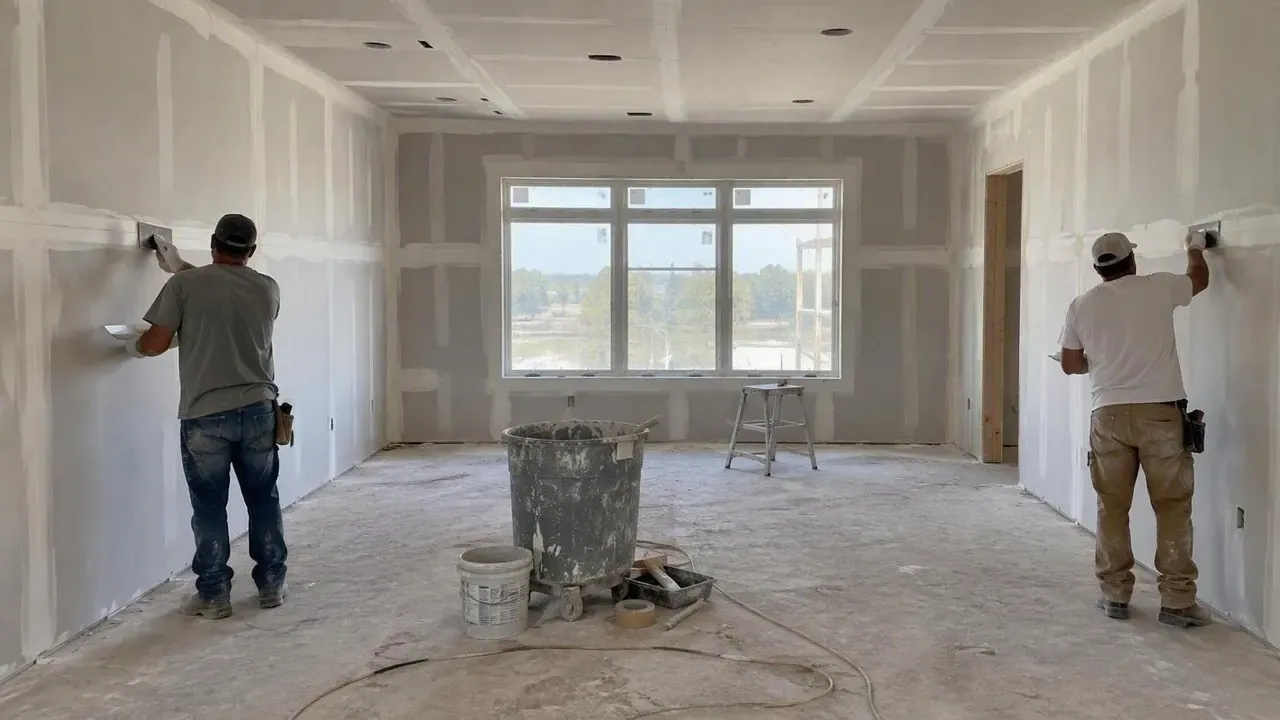
Drywall taping and finishing is the work of covering joints, corners and fasteners with tape and joint compound, then sanding to a smooth surface ready for primer. It turns hung board into a wall that looks like one continuous surface.
It suits DIY homeowners and owner-builders who hung their own board, contractors who want a specialist finisher, and anyone whose previous tape job is cracking or ridging. Our finishing scope includes:
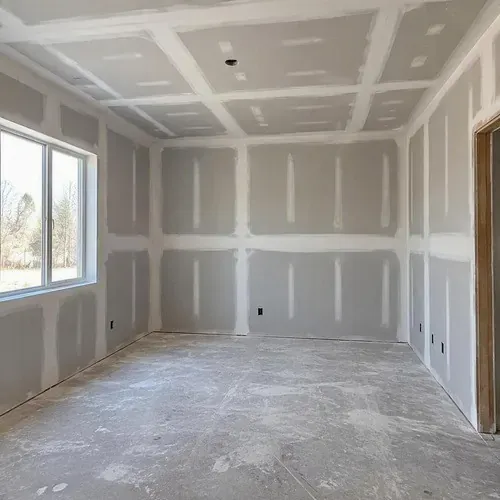
Every finishing job is one of the six types below, each with its own method and tools.
Flat joints run along the tapered factory edges; butt joints meet at the untapered ends and need a much wider feather. Paper tape is stronger than mesh on both.
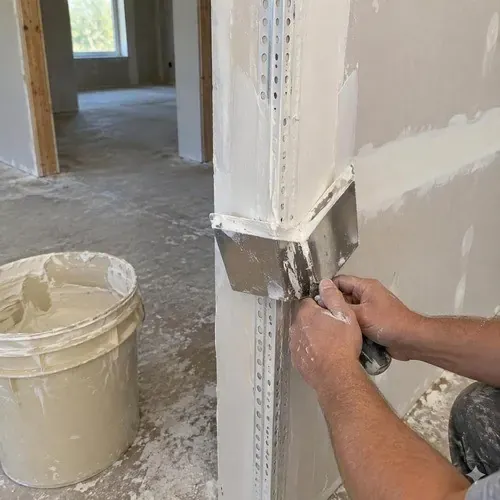
Paper-faced metal bead on outside corners resists cracking far better than plain metal bead. Inside corners get paper tape or no-coat bead, and tear-away bead where board meets a window return.
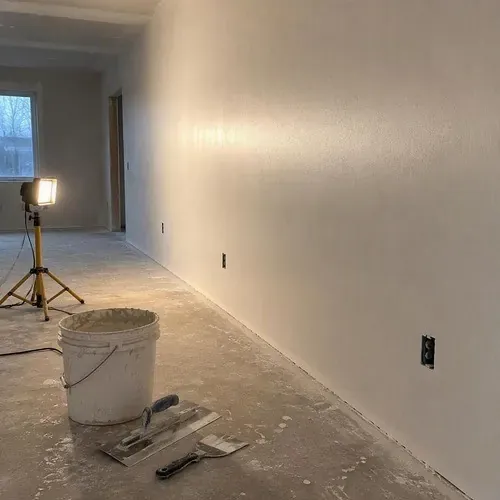
A skim coat is a thin layer of compound over the entire surface that evens out paper and joint texture. We roll and knife it, or spray it on larger areas.
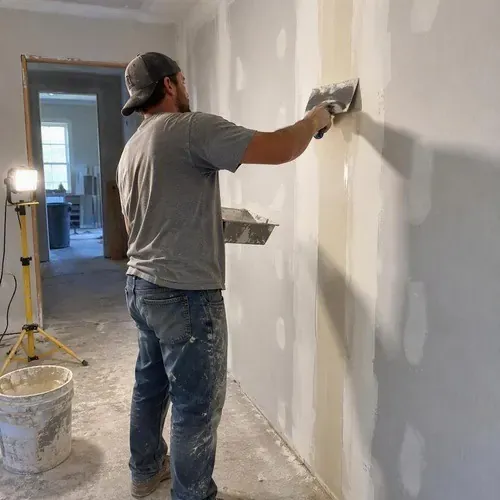
Knockdown, orange peel and stipple are applied after the tape coats. Matching an existing texture is covered on our textured ceiling and wall repair page.
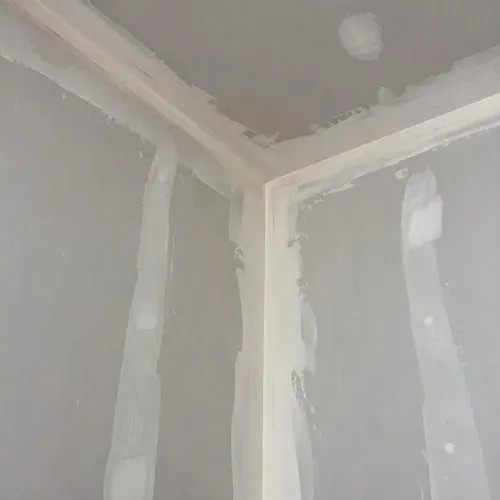
Blistered tape, crowned joints and sanding scuffs through the face paper are cut out or sealed with a primer, then refinished properly.
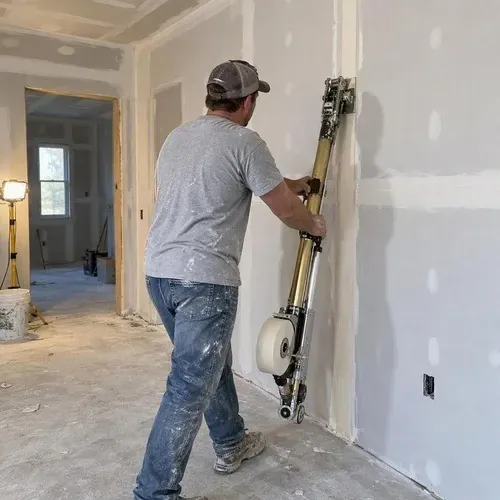
On whole houses and commercial work we use an automatic taper and flat boxes. They lay consistent compound thickness quickly, which keeps big jobs on schedule.
Free written quotes with the finish level spelled out.
The materials matter as much as the hands. These are the main choices on a finishing job and why we pick each one.
| Material | What it is | When we use it |
|---|---|---|
| Paper tape | Creased paper strip bedded in wet compound | All flat, butt and inside-corner joints for strength |
| Fibreglass mesh tape | Self-adhesive open-weave tape | Small repairs only; it cracks on joints that move |
| Setting compound | Powder mixed with water that hardens chemically in 20 to 90 minutes (Sheetrock Easy Sand, Durabond) | Tape and fill coats: low shrinkage, strong bond |
| All-purpose premix | Ready-mixed compound that dries by evaporation | Embedding and general coats on smaller jobs |
| Lightweight topping | Premix that sands easily and shrinks little | Final coat and skim coats |
| Paper-faced metal bead | Metal corner with paper flanges | Outside corners; resists edge cracking |
Level 4 suits most painted rooms, and Level 5 is for gloss paint, large windows and strong side light. To test a wall, hold a work light flat against it and look along the surface; anything you see will show in afternoon sun.
| Finish level | Best for | Skip it when |
|---|---|---|
| Level 3 | Walls that will get a heavy texture | You want flat, smooth paint |
| Level 4 | Flat or eggshell paint in bedrooms, halls and basements | You have gloss paint or strong side light |
| Level 5 | Satin or gloss paint, south-facing glass, open-plan ceilings | The room is a garage or storage space |
Level 5 adds a full skim coat, so it costs more. It is the finish most of our drywall installation clients choose for great rooms.
A finishing job runs in five stages over several days, because each coat has to harden before the next.
We fix sunken screws, open gaps over 1/4 in. and broken paper before any tape goes on.
Paper tape is bedded in setting compound on every joint, and bead is set on outside corners.
A wider coat covers the tape and fasteners, feathered several inches past each joint.
The final coat is feathered wider again, 12 in. or more on butt joints, then left to dry fully.
Vacuum sanding, then a work-light check. Level 5 rooms get a skim coat and a final light sand.
Send us a few photos for a faster estimate.
Most tape failures trace back to a few shortcuts. These are the problems we fix most often on other people's work:
Taping is quoted per square foot of board or per sheet, and both depend on the same factors below.
| Factor | Effect on price |
|---|---|
| Ceiling height | Above 9 ft needs stilts, a baker scaffold or staging. |
| Butt joint count | Butt joints take more compound and wider feathering than factory edges. |
| Cathedral and vaulted ceilings | Angles and staging slow every coat. |
| Corners and bead | Rooms with many outside corners, arches or window returns take longer. |
| Level 5 finish | Adds a full skim coat and extra sanding. |
| Condition of the hang | Poorly hung board needs correcting before taping starts. |
A typical room takes three to four visits over four to six days. Setting compound lets us coat faster, but the final premix coat still needs about 24 hours to dry.
A humid Kingston August can add a day to every coat, while a dry February with the furnace running usually does not. We sand with vacuum-extraction sanders on HEPA extractors and seal the room with zip doors so you can live in the rest of the house.
Straight answers to the questions we hear on site visits every week.
A tape coat plus two fill coats is standard for Level 4, sanded after the final coat. Level 5 adds a skim coat over everything.
Premixed compound needs about 24 hours, longer when it is humid or cool. Setting compounds harden in 20 to 90 minutes depending on the type.
Usually, yes. We fix sunken fasteners, open gaps and broken paper first, and show you any section so poorly hung that no finish will hide it.
Mostly with vacuum-extraction sanders for dust control. We hand sand corners and detail areas a power sander cannot reach safely.
Paper tape is better for joints and corners because it is stronger and does not stretch. Mesh tape is fine for small patches but tends to crack on longer joints.
Finishing ties into most of what we do. Small damage goes to our drywall repair team, and a skim coat over a scraped ceiling is the last step of popcorn ceiling removal.
Tell us the square footage or sheet count, ceiling heights and the finish level you want. Photos of the hang help us price tape-only work accurately.